Thursday, October 11, 2007

Raja Yoga

Rāja Yoga ("royal yoga", "royal union", also known as Classical Yoga or simply Yoga) is one of the six orthodox (astika) schools of Hindu philosophy, outlined by Patanjali in his Yoga Sutras. It is also sometimes referred to as Aṣṭānga (eight-limbed) yoga because there are eight aspects to the path to which one must attend. Raja yoga is concerned principally with the cultivation of the mind using meditation (dhyana) to further one's acquaintance with reality and finally achieve liberation.

Concept

The term Rāja Yoga is a retronym, introduced in the 15th century Hatha Yoga Pradipika to distinguish the school based on the Yoga Sutras from the new current of Hatha Yoga.

Raja Yoga is so-called because it is primarily concerned with the mind. The mind is traditionally conceived as the "king" of the psycho-physical structure which does its bidding (whether or not one has realized this). Because of the relationship between the mind and the body, the body must be first "tamed" through self-discipline and purified by various means (see Hatha Yoga). A good level of overall health and psychological integration must be attained before the deeper aspects of yoga can be pursued. Humans have all sorts of addictions and obsessions and these preclude the attainment of tranquil abiding (meditation). Through restraint (yama) such as celibacy, abstaining from drugs and alcohol and careful attention to one's actions of body, speech and mind, the human being becomes fit to practise meditation. This yoke that one puts upon oneself (discipline) is another meaning of the word yoga.
Every thought, feeling, perception, or memory you may have causes a modification, or ripple, in the mind. It distorts and colors the mental mirror. If you can restrain the mind from forming into modifications, there will be no distortion, and you will experience your true Self.
- Swami Satchidananda
Patañjali's Yoga Sutras begin with the statement yogaś citta-vṛtti-nirodhaḥ (1.2), "Yoga limits the oscillations of the mind". They go on to detail the ways in which mind can create false ideations and advocate meditation on real objects, which process, it is said, will lead to a spontaneous state of quiet mind, the "Nirbija" or "seedless state", in which there is no mental object of focus.
Practices that serve to maintain for the individual the ability to access this state may be considered Raja Yoga practices. Thus Raja Yoga encompasses and differentiates itself from other forms of Yoga by encouraging the mind to avoid the sort of absorption in obsessional practice (including other traditional yogic practices) that can create false mental objects.
In this sense Raja Yoga is "king of yogas": all yogic practices are seen as potential tools for obtaining the seedless state, itself considered to be the starting point in the quest to cleanse Karma and obtain Moksha or Nirvana. Historically, schools of yoga that label themselves "Raja" offer students a mix of yogic practices and (hopefully or ideally) this philosophical viewpoint

Practice


Raja Yoga aims at controlling all thought-waves or mental modifications. While a Hatha Yogi starts his Sadhana with Asanas (postures) and Pranayama, a Raja Yogi starts his Sadhana with the mind, although a certain minimum of asanas and pranayamas are usually included as a preparation for the meditation and concentration.

Eight limbs of Ashtanga Yoga

The eight limbs of Ashtanga Yoga are:

  • Yama - Code of conduct - self-restraint
  • Niyama - religious observances - commitments to practice, such as study and devotion
  • Āsana - integration of mind and body through physical activity
  • Pranayama - regulation of breath leading to integration of mind and body
  • Pratyahara - abstraction of the senses, withdrawal of the senses of perception from their objects
  • Dharana - concentration, one-pointedness of mind
  • Dhyana - meditation (quiet activity that leads to samadhi)
  • Samadhi - the quiet state of blissful awareness, superconscious state

Yama


Yama consists of five parts: Ahimsa (non-violence), Satya (truthfulness), Asteya (not stealing), Brahmacharya (celibacy), and Aparigraha (non-covetousness). Ahimsa is perfect harmlessness and positive love also. This removes the brutal nature in man and strengthens the will.

Niyama


Niyama is observance of five canons: Saucha (internal and external purity), Santosha (contentment), Tapas (Sanskrit) (austerity), Svadhyaya (study of religious books and repetitions of Mantras), and Ishvarapranidhana (self-surrender to God, and His worship).

He who practises meditation without ethical perfection, without the practice of Yama-Niyama cannot obtain the fruits of meditation. Purify your mind first through the practice of Yama-Niyama. Then practice regular meditation. Then you will attain illumination.

Asana


Any easy, steady, comfortable pose is Asana. Asanas steady the body. Posture is mastered by releasing tension and meditation on the unlimited.

Pranayama


Pranayama checks the outgoing tendencies of the mind. It is often misunderstood for breathing exercises. Prana means life force, while yama means to gain control

Pratyahara


Pratyahara gives inner spiritual strength. It removes all sorts of distractions. It develops will-power.

Dharana


Real Yoga starts from concentration. Concentration merges into meditation. Meditation ends in Samadhi. Retention of breath, Brahmacharya, Satvic (pure) food, seclusion, silence, Satsanga (being in the company of a guru), and not mixing much with people are all aids to concentration. Concentrate on Trikuti (the space between the two eyebrows) with closed eyes is preferred. The mind can be easily controlled, as this is the seat for the mind.

Dhyana


Sleep, tossing of mind, attachment to objects, subtle desires and cravings, laziness, lack of Brahmacharya, gluttony are all obstacles in meditation. Reduce your wants. Cultivate dispassion. You will have progress in Yoga. Vairagya thins out the mind. Do not mix much. Do not talk much. Do not walk much. Do not eat much. Do not sleep much. Do not exert much. Never wrestle with the mind during meditation. Do not use any violent efforts at concentration. If evil thoughts enter your mind, do not use your will force in driving them. You will tax your will. You will lose your energy. You will fatigue yourself. The greater the efforts you make, the more the evil thoughts will return with redoubled force. Be indifferent. Become a witness of those thoughts. Substitute divine thoughts. They will pass away. Never miss a day in meditation. Regularity is of paramount importance. When the mind is tired, do not concentrate. Do not take heavy food at night.

The mind passes into many conditions or states as it is made up of three qualities-Sattva, Rajas and Tamas. Kshipta (wandering), Vikshipta (gathering), Mudha (ignorant), Ekagra (one-pointed), and Nirodha (contrary) are the five states of the mind.

By controlling the thoughts the Sadhaka attains great Siddhis. He becomes an adept. He attains Asamprajnata Samadhi or Kaivalya. Do not run after Siddhis. Siddhis are great temptations. They will bring about your downfall. A Raja Yogi practices Samyama or the combined practice of Dharana, Dhyana and Samadhi at one and the same time and gets detailed knowledge of an object.

Control the mind by Abhyasa (practice) and Vairagya (dispassion). Any practice which steadies the mind and makes it one-pointed is Abhyasa. Dull Vairagya will not help you in attaining perfection in Yoga. You must have Para Vairagya or Theevra Vairagya, intense dispassion.

Samadhi


Meditation on OM with Bhava and its meaning removes obstacles in Sadhana and helps to attain Samadhi. Avidya (ignorance), Asmita (egoism), Raga-Dvesha (likes and dislikes), Abhinivesha (clinging to mundane life) are the five Kleshas or afflictions. Destroy these afflictions. You will attain Samadhi.

Samadhi is of two kinds:

  • Savikalpa, Samprajnata or Sabija; and
  • Nirvikalpa, Asamprajnata or Nirbija.

In Savikalpa or Sabija, there is Triputi or the triad (knower, known and knowledge). The samskaras are not burnt or freed. Savitarka, Nirvitarka, Savichara, Nirvichara, Sasmita and Saananda are the different forms of Savikalpa Samadhi. In Nirbija Samadhi or Asamprajnata Samadhi there is no triad.

A Bhakta gets Bhava-Samadhi, a Jnani gets Badha-Samadhi, a Raja Yogi gets Nirodha Samadhi.

Breath


Breathing transports oxygen into the body and carbon dioxide out of the body. Aerobic organisms require oxygen to create energy via respiration, in the form of energy-rich molecules such as glucose. The medical term for normal relaxed breathing is eupnoea. Organisms breathe to avoid death from asphyxiation.

Mechanics

Breathing in, or inhaling, is usually an active movement, with the contraction of the diaphragm muscles needed. At rest, breathing out, or exhaling, is normally a passive process powered by the elastic recoil of the chest, similar to a deflating balloon. The following organs are used in respiration: mouth, nose, gullet, windpipe, lungs, diaphragm.

Gas exchange

Breathing is only part of the process of delivering oxygen to where it is needed in the body. The process of gas exchange occurs in the alveoli by passive diffusion of gasses between the alveolar gas and the blood passing by in the lung capillaries. Once in the blood the heart powers the flow of dissolved gasses around the body in the circulation.

As well as carbon dioxide, breathing also results in loss of water from the body. Exhaled air has a relative humidity of 100% because of water diffusing across the moist surface of breathing passages and alveoli.

Control of breathing

Breathing is one of the few bodily functions which, within limits, can be controlled both consciously and unconsciously. Conscious attention to breathing is common in many forms of meditation, specifically anapana and other forms of yoga. In swimming, cardio fitness, speech or vocal training, one learns to discipline one's breathing, initially consciously but later sub-consciously, for other purposes than life support.

Unconsciously, breathing is controlled by specialized centers in the brainstem, which automatically regulate the rate and depth of breathing depending on the body’s needs at any time. When carbon dioxide levels increase in the blood, it reacts with the water in blood, producing carbonic acid. The drop in the blood's pH will then cause the medulla oblongata signalling center in the brain to send nerve impulses to the diaphragm and the intercostal muscles, increasing the rate of breathing. While exercising, the level of carbon dioxide in the blood increases due to increased cellular respiration by the muscles. This stimulates chemoreceptors in the carotid and aortic bodies in the blood system to send nerve impulses to the inspiration centre. The inspiration centre sends impulses to the diaphragm and intercostal muscles through the phrenic and thoracic nerves. The diaphragm and intercostal muscles contract at a higher rate.

During rest, the level of carbon dioxide is lower, so breathing rate is lower. This ensures an appropriate amount of oxygen is delivered to the muscles and other organs. It is important to reiterate that it is the buildup of carbon dioxide making the blood acidic that elicits the desperation for a breath much more than lack of oxygen. This automatic control of respiration can be impaired in premature babies, or by drugs or disease.

It is not possible for a healthy person to voluntarily stop breathing indefinitely. If we do not inhale, the level of carbon dioxide builds up in our blood, and we experience overwhelming air hunger. This irrepressible reflex is not surprising given that without breathing, the body's internal oxygen levels drop dangerously low within minutes, leading to permanent brain damage followed eventually by death. However, there have been instances where people have survived for as long as two hours without air; this is only possible when submerged in cold water, as this triggers the mammalian diving reflex.

If a healthy person were to voluntarily stop breathing (i.e. hold his or her breath) for a long enough amount of time, he or she would lose consciousness, and the body would resume breathing on its own. This results that one cannot suffocate themself with this method, unless one's breathing was also restricted by something else (e.g. water, see drowning)

Hyperventilating causes a drop in CO2 below normal levels, lowering blood acidity to trick the brain into thinking it has more oxygen than is actually present. Hyperventilating can cause your blood oxygen levels to go to dangerous levels.

Relationship to death

Breath is sometimes used as a metaphor for life itself, and often "last breath" is the most obvious sign that death has occurred. The association between the end of life and breathing is not absolute, however. As modern treatment can now take over the process of breathing by mechanical ventilation, or cardiopulmonary resuscitation (CPR), breathing can be restarted if it stops. Because of this, modern deaths are now better defined in terms of brain disfunction.

Composition of air

The air we inhale is roughly 78% nitrogen, 21% oxygen, 0.96% argon and 0.04% carbon dioxide, helium, water, and other gases. (% by volume)

The permanent gases in air we exhale are roughly 78% nitrogen, 15% to 18% oxygen, 4% to 5% carbon dioxide and 0.96% argon (% by volume). Additionaly vapours and trace gases are present: 5% water vapour, several parts per million (ppm) of hydrogen and carbon monoxide, 1 part per million (ppm) of ammonia and less than 1 ppm of acetone, methanol, ethanol and other volatile organic compounds.

Not all of the oxygen breathed in is replaced by carbon dioxide; around 16% of what we breathe out is still oxygen. The exact amount of exhaled oxygen and carbon dioxide varies according to the fitness, energy expenditure and diet of that particular person. Also our reliance on this relatively small amount of oxygen can cause overactivity or euphoria in pure or oxygen rich environments.

Cultural significance

In Tai Chi Chuan, aerobic training is combined with breathing to exercise the diaphram muscles, and to train effective posture, which both make better use of the body's energy. In music, breath is used to play wind instrument wind instruments and many aerophones. Laughter, physically, is simply repeated sharp breaths. Hiccups and yawns are other breath-related phenomena.

Ancients commonly linked the breath to a life force. The Hebrew Bible refers to God breathing the breath of life into clay to make Adam a living soul (nephesh, roughly "breather"). It also refers to the breath as returning to God when a mortal dies. The terms "spirit," "qi," and "psyche" are related to the concept of breath.

Yoga


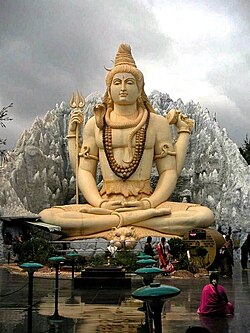
Statue of Shiva performing Yogic meditation

Yoga (Sanskrit: योग Yoga, IPA: [joːgə]) is a group of ancient spiritual practices originating in India. As a general term in Hinduism it has been defined as referring to "technologies or disciplines of asceticism and meditation which are thought to lead to spiritual experience and profound understanding or insight into the nature of existence." Yoga is also intimately connected to the religious beliefs and practices of the other Indian religions.

Outside India, Yoga is mostly associated with the practice of asanas (postures) of Hatha Yoga or as a form of exercise, although it has influenced the entire Indian religions family and other spiritual practices throughout the world.

Hindu texts discussing different aspects of yoga include the Upanishads, the Bhagavad Gita, the Yoga Sutras of Patanjali, the Hatha Yoga Pradipika, the Shiva Samhita, and many others.

Major branches of Yoga include: Hatha Yoga, Karma Yoga, Jnana Yoga, Bhakti Yoga, and Raja Yoga. Raja Yoga, known simply as Yoga in the context of Hindu philosophy, is one of the six orthodox (āstika) schools of thought, established by the Yoga Sutras of Patanjali.


Etymology


The Sanskrit term yoga has a wide range of different meanings. It is derived from the Sanskrit root yuj, "to control", "to yoke", or "to unite". Common meanings include "joining" or "uniting", and related ideas such as "union" and "conjunction" Another conceptual definition is that of "mode, manner, means" or "expedient, means in general".

History of Yoga


Indus Valley seals

A seal from the Indus Valley Civilization, showing a figure in meditation posture.

Several seals discovered at Indus Valley Civilization (c. 3300–1700 BC) sites depict figures in a yoga or meditation like posture. The most widely known of these was named the "Pashupati seal" by its discoverer, John Marshall, who believed that it represented a "proto-Shiva" figure.Many modern authorities discount the idea that this "Pashupati" (Lord of Animals, Sanskrit paśupati) represents a Shiva or Rudra figure.

There is considerable evidence to support the idea that the image's posture "is a form of ritual discipline, suggesting a precursor to yoga" according to archaeologist Gregory Possehl (who also questions the proto-Shiva theory). He points to sixteen other specific "yogi glyptics" in the corpus of Mature Harappan artifacts as pointing to Harappan devotion to "ritual discipline and concentration". These images show that the yoga pose "may have been used by deities and humans alike". He suggests that yoga goes back to the Indus Valley Civilization.

Gavin Flood characterizes these views as "speculative", saying that it is not clear from the 'Pashupati' seal that the figure is seated in a yoga posture, or even that the shape is intended to represent a human figure, though it is nevertheless possible that there are echoes of Shaiva iconographic themes, such as half-moon shapes resembling the horns of a bull. Other authorities do support the idea that the 'Pashupati' figure shows a figure in a yoga or meditation posture. They include Archaeologist Jonathan Mark Kenoyer, current Co-director of the Harappa Archaeological Research Project in Pakistan and Indologist Heinrich Zimmer.

In 2007, terracotta seals were discovered in the Cholistan Desert in Pakistan. Punjab University Archaeology Department Chairman Dr. Farzand Masih described one of the seals as similar to the previously discovered Mohenjodaro seals, with three pictographs on one side and a "yogi" on the other side.

Literary sources


Ascetic practices (tapas) are referenced in the Brāhmaṇas (900 BCE and 500 BCE),[28] early commentaries on the vedas. In the Upanishads, an early reference to meditation is made in Brihadaranyaka Upanishad,[29] one of the earliest Upanishads (approx. 900 BCE). The main textual sources for the evolving concept of Yoga are the middle Upanishads, (ca. 400 BCE), the Mahabharata (5th c. BCE) including the Bhagavad Gita (ca. 200 BCE), and the Yoga Sutras of Patanjali (200 BCE-300 CE).

Bhagavad Gita


The Bhagavad Gita ('Song of the Lord'), thought to have been composed in roughly the 2nd century BC, uses the term yoga extensively in a variety of senses. Of many possible meanings given to the term in the Gita, most emphasis is given to these three:

  • Karma yoga: The yoga of action
  • Bhakti yoga: The yoga of devotion
  • Jnana yoga: The yoga of knowledge

The influential commentator Madhusudana Sarasvati (b. circa 1490) divided the Gita's eighteen chapters into three sections, each of six chapters. According to his method of division the first six chapters deal with Karma yoga, the middle six deal with Bhakti yoga, and the last six deal with Jnana (knowledge). This interpretation has been adopted by some later commentators and rejected by others

Wednesday, October 10, 2007

Yoga Sutras of Patanjali


In Indian philosophy, Yoga is the name of one of the six orthodox philosophical schools. The Yoga philosophical system is closely allied with the Samkhya school. The Yoga school as expounded by Patanjali accepts the Samkhya psychology and metaphysics, but is more theistic than the Samkhya, as evidenced by the addition of a divine entity to the Samkhya's twenty-five elements of reality. The parallels between Yoga and Samkhya were so close that Max Müller says that "the two philosophies were in popular parlance distinguished from each other as Samkhya with and Samkhya without a Lord...." The intimate relationship between Samkhya and Yoga is explained by Heinrich Zimmer:

The sage Patanjali is regarded as the founder of the formal Yoga philosophy. The Yoga Sutras of Patanjali are ascribed to Patanjali, who, may have been, as Max Müller explains, "the author or representative of the Yoga-philosophy without being necessarily the author of the Sutras." Indologist Axel Michaels is dismissive of claims that the work was written by Patanjali, characterizing it instead as a collection of fragments and traditions of texts stemming from the second or third century. Gavin Flood cites a wider period of uncertainty for the composition, between 100 BCE and 500 CE.

Patanjali's yoga is known as Raja yoga, which is a system for control of the mind. Patanjali defines the word "yoga" in his second sutra, which is the definitional sutra for his entire work:

This terse definition hinges on the meaning of three Sanskrit terms. I. K. Taimni translates it as "Yoga is the inhibition (nirodhaḥ) of the modifications (vṛtti) of the mind (citta)". Swami Vivekananda translates the sutra as "Yoga is restraining the mind-stuff (Citta) from taking various forms (Vrittis)." Gavin Flood translates the sutra as "yoga is the cessation of mental fluctuations".

A sculpture of a Hindu yogi in the Birla Mandir, Delhi

Patanjali's writing also became the basis for a system referred to it as "Ashtanga Yoga" ("Eight-Limbed Yoga"). This eight-limbed concept derived from the 29th Sutra of the 2nd book became a feature of Raja yoga, and is a core characteristic of practically every Raja yoga variation taught today.The Eight Limbs of yoga practice are:

(1) Yama (The five "abstentions"): violence, lying, theft, (illicit) sex, and possessions
(2) Niyama (The five "observances"): purity, contentment, austerities, study, and surrender to god
(3) Asana: Literally means "seat", and in Patanjali's Sutras refers to seated positions used for meditation. Later, with the rise of Hatha yoga, asana came to refer to all the "postures"
(4) Pranayama ("Life Force Control"): Control of prāna, life force, or vital energy, particularly, the breath
(5) Pratyahara ("Abstraction"): Reversal of the sense organs
(6) Dharana ("Concentration"): Fixing the attention on a single object
(7) Dhyana ("Meditation"): Intense contemplation of the nature of the object of meditation
(8) Samadhi ("Liberation"): merging consciousness with the object of meditation

It details every aspect of the meditative process, and the preparation for it. The book is available in as many as 40 English translations, both in-print and on-line.

Hatha Yoga Pradipika


Hatha Yoga is a particular system of Yoga described by Yogi Swatmarama, a yogic sage of the 15th century in India, and compiler of the Hatha Yoga Pradipika. Hatha Yoga is a development of — but also differs substantially from — the Raja Yoga of Patanjali, in that it focuses on shatkarma, the purification of the physical as leading to the purification of the mind (ha) and prana, or vital energy (tha). In contrast, the Raja Yoga posited by Patanjali begins with a purification of the mind (yamas) and spirit (niyamas), then comes to the body via asana (body postures) and pranayama (breath). Hatha yoga contains substantial tantric influence, and marks the first point at which chakras and kundalini were introduced into the yogic canon. Compared to the seated asanas of Patanjali's Raja yoga which were seen largely as a means of preparing for meditation, it also marks the development of asanas as full body 'postures' in the modern sense.

Hatha Yoga in its many modern variations is the style that most people actually associate with the word "Yoga" today. Because its emphasis is on the body through asana and pranayama practice, many western students are satisfied with the physical health and vitality it develops and are not interested in the other six limbs of the complete Hatha yoga teaching, or with the even older Raja Yoga tradition it is based on.

Yoga in other traditions


Yoga and Buddhism


Yoga is intimately connected to the religious beliefs and practices of the Indian religions. The influence of Yoga is also visible in Buddhism, which is distinguished by its austerities, spiritual exercises, and trance states.

Yogacara Buddhism

Yogacara (Sanskrit: "Practice of Yoga [Union]" ), also spelled yogāchāra, is a school of philosophy and psychology that developed in India during the 4th to 5th centuries.

Yogacara received the name as it provided a yoga, a framework for engaging in the practices that lead to the path of the bodhisattva. The Yogacara sect teaches yoga in order to reach enlightenment.

Zen (Ch`an) Buddhism

Zen (the name of which derives from the Sanskrit "dhyana" via the Chinese "ch'an") is a form of Mahayana Buddhism. The Mahayana school of Buddhism is noted for its proximity with Yoga. In the west, Zen is often set alongside Yoga; the two schools of meditation display obvious family resemblances. This phenomenon merits special attention since the Zen Buddhist school of meditation has some of its roots in yogic practices. Certain essential elements of Yoga are important both for Buddhism in general and for Zen in particular.

Tibetan Buddhism

Yoga is central to Tibetan Buddhism. In the Nyingma tradition, practitioners progress to increasingly profound levels of yoga, starting with Mahā yoga, continuing to Anu yoga and ultimately undertaking the highest practice, Ati yoga. In the Sarma traditions, the Anuttara yoga class is equivalent. Other tantra yoga practices include a system of 108 bodily postures practiced with breath and heart rhythm. Timing in movement exercises is known as Trul khor or union of moon and sun (channel) prajna energies. The body postures of Tibetan ancient yogis are depicted on the walls of the Dalai Lama's summer temple of Lukhang.

Yoga and Tantra


Tantrism, is a practice that is supposed to alter the relation of the individual practitioner of Tantrism to the ordinary social, religious, and logical reality in which he or she lives. Through Tantric practice an individual perceives reality as maya, illusion, and the individual achieves liberation from it.

This particular path to salvation among the several offered by Hinduism, links Tantrism to those practices of Indian religions, such as yoga, meditation, and social renunciation, which are based on temporary or permanent withdrawal from social relationships and modes.

During tantric practices and studies, the student is instructed further in meditation technique, particularly chakra meditation. This is often in a limited form in comparison with the way this kind of meditation is known and used by Tantric practitioners and yogis elsewhere, but is more elaborate than the initiate's previous meditation. It is considered to be a kind of Kundalini Yoga for the purpose of moving the Goddess into the chakra located in the "heart," for meditation and worship.

Goal of Yoga


There are numerous opinions on what the goal of Yoga may be, although generally they involve some kind of union, either of a personal or a non-personal nature.

Within the monist schools of Advaita Vedanta and Shaivism this perfection takes the form of Moksha, which is a liberation from all worldly suffering and the cycle of birth and death (Samsara) at which point there is a cessation of thought and an experience of blissful union with the Supreme Brahman. For the dualistic bhakti schools of Vaishnavism, bhakti itself is the ultimate goal of the yoga process[64], wherein perfection culminates in an eternal relationship with Vishnu or one of his associated avatars such as Krishna or Rama.

Yoga in Daily Life

Yoga in Daily Life® by Mahamandaleshwar Paramhans Swami Maheshwarananda is a comprehensive system of Yoga with a holistic approach to health, like Ayurveda. The main goal of the Yoga in Daily Life system is to attain and maintain physical health, mental health, social health, spiritual health and eventually achieve self-realization. Based on the authentic Yoga tradition Yoga in Daily Life contains the pure essence of the original Yoga teachings and was developed specifically to suit the mind and lifestyle of modern civilisation.

This system of Yoga offers a simple means of relief from both physical and mental stress – guiding the way to achieve good health, harmony, inner peace and spiritual development. Yoga in Daily Life is not limited only to the physically fit and able, but can be practised by people of all ages and states of health. Yoga in Daily Life has been introduced within the education system, at schools and universities, in rehabilitation spas and hospitals as well as in many yoga-centres throughout the world. Today, incorporated non-profit Yoga in Daily Life Associations are established in twenty-four countries around the world, each being actively involved in local, national and international community projects.
Basic teachings

All classical Yoga exercises like Asana and Pranayama and the four Yoga ways namely Raja Yoga, Bhakti Yoga, Gyana or Jnana Yoga and Karma Yoga are included in this system.

Additionally the system completes with detailed teachings about Chakras and Kundalini, Hatha Yoga Kriyas, Kathu Pranam, Self-Inquiry and Mantra Meditation, Raja Kriya and Yoga Nidra as well as vegetarian nourishment and Ayurveda guidelines.

Asana, Pranayama, Relaxation, Concentration

The system Yoga in Daily Life® (ISBN 3-85052-000-5) has an eight-level-structure, which should be followed systematically, level by level. The exercises are structured so that an optimal effect for body, mind and soul is given. The first part of the exercises comprises the Sarav Hitta Asanas (exercises "good for everyone"). This preliminary exercises, practised prior to the true Yoga Asanas, offer an easy entry into the complete system. The first level has six parts, each part should be practised at least two weeks. The levels two till six should each be practised for six weeks, together with Pranayama (it is the conscious and deliberate control and regulation of the breath; Prana means breath, Ayam means to control, to regulate), Meditation and Yoga Nidra ("sleep of the yogis"). Each exercise sequence constitutes a preparation for the next level.

Chakras and Kundalini

In the book The Hidden Power in Humans - Chakras and Kundalini (ISBN 3-85052-197-4) the main 8 Chakras namely Muladhara, Swadhisthana, Manipura, Anahata, Vishuddha, Ajna, Bindu and Sahasrara and the Nadis (energy channels and energy transmitters) are explained. Detailed information about their attributes, the attributes of the Koshas (physical, mental and astral body), the 5 Tattvas (PRITHVĪ – Earth, ĀPAS – Water, TEJAS – Fire, VĀYU – Air, ĀKĀSHA – Space) and 3 Gunas (RAJAS – activity, movement, restlessness, passion; TAMAS – rigidity, laziness, darkness, ignorance; SATTVA – harmony, light, purity, knowledge), the Antahkaranas (MANAS - Mind, BUDDHI - Intellect, CHITTA - Consciousness, AHAMKĀRA - Ego) and Indriyas (senses) are given. Furthermore Jivatma, Atma and Paramatma (Soul, Self and God), the two ways of life Pravritti and Nivritti, the three obstacles on the spiritual path (Mala, Vikshepa, Avarana) and the 14 cosmic levels (Chaturdashana Lokas) are explained. Exercises for every Chakra are given. Meditation practise for awekening the Chakras include Pranayama together with Bandha. Bandha means to lock, close-off, to stop. There are four types of Bandhas (Mul Bandha - anal lock, Uddiyan Bandha - raising of the diaphragm, Jalandhar Bandha - chin lock, Maha Bandha - practice of all three Bandhas at the same time). Generally, the breath is held during the practice of the Bandhas.

Kundalini Yoga is a pure, spiritual science that leads to enlightenment and god-realization under the guidance of a spiritual Master. Sri Mahaprabhuji said: “Kundalini is the divine Mother. A true mother never causes harm or does anything bad to her children.” The path of the Kundalini proceeds from the Muladhara Chakra at the lower end of the spinal column up to the Sahasrara Chakra at the top of the head. But its awakening is not a physical occurrence; it consists exclusively of a development in consciousness and awakening of inner knowledge.

Hatha Yoga Kriyas

In the system Yoga in Daily Life® all Hatha Yoga Kriyas techniques in particular Neti (purification of the nose), Dhauti (purification of the esophageus and stomach), Nauli (turning of the abdominal muscles), Basti and Shank Prakshalan (complete cleaning of the intestines), Kapal Bhati Pranayam (cleansing of the frontal sinuses) and Tratak (concentration on a point or candle flame) are taught.

Khatu Pranam

This exercise sequence of 20 Asanas harmonises body, mind and soul. In the initial stage of practice, focus is given to the physical benefits. Khatu Pranam strengthens, stretches and relaxes the muscles of the whole body, promotes flexibility of the spine and regulates glandular activity. The more advanced levels of Khatu Pranam are practiced in co-ordination with the breath and with concentration on the energy centres of the body (Chakras), repeating a Mantra for every Asana..

Raja Kriya and Yoga Nidra

This lineage in teaching Raja Kriya and Yoga Nidra stems from Paramyogeshwar Sri Devpuriji, who received his initiation from Siddha Guru Sri Alakh Puriji, according to the book Sri Lila-Amrit (ISBN 3-85052-104-4), the biography of Sri Deep Narayan Mahaprabhuji, written by Dharmsamrat Paramhans Swami Madhavananda. Sri Devpuriji passed the techniques on to Sri Mahaprabhuji and it was taught to his disciples since 1880. Raja Kriya is a Meditation technique which combined Asana, Pranayama, Bandha and Mudra with Concentration, Imagination and repeating of Mantra and should be practised once a day.

Yoga Nidra is in the beginning used just as a physical and mental relaxation technique but should not be confused with techniques of auto-suggestion or autogenic training. The true sleep of a Yogi is a state of consciousness in which the Yogi is connected with that divine energy pervading the whole cosmos. This energy is beyond space and time and during this state of consciousness the Yogi can see past, present and future. Through Yoga Nidra the Yogi can work through karmas, as this clarity penetrates levels of the unconsciousness and subconsciousness. Experienced Yogis use Yoga Nidra for astral travels and in its highest level it leads to Samadhi.

Self-Inquiry and Mantra Meditation

The technique of Self-Inquiry Meditation develops understanding and forgiveness and it purifies the subconscious. The thinking becomes well ordered and clear and through this the practising is able to overcome and avoid many difficulties in life and it will lead to self-knowledge and self-realization.

A Mantra is the causal power of words; it is a syllable, a word or a sequence of words with a high spiritual vibration. There are three types of Mantras. PRAYER, GURU Mantra (represents the essence of prayer) and BĪJA Mantra (seed Mantra, assigned to each Chakra). All elements and energies in the cosmos can be influenced and guided by Mantras. A spiritual Mantra always contains the word OM (Aum) and the name of a divine incarnation. Practising Mantra includes five stages (LIKHITA – through writing, VAIKHARĪ – through speaking, UPĀMSHU – through whispering, MĀNASA – through thinking, AJAPĀ – through uninterrupted inner repetition).

Vegetarian Nourishment and Ayurveda

A high value of Yogis is living a healthy lifestyle in harmony with nature and following a vegetarian diet. To live as a vegetarian is an ethical principle, a question of responsibility for all living beings. With each breath we absorb not only oxygen, but also Prana. Prana is cosmic energy, the power in the universe that creates, preserves and changes. It is the basic element of life and consciousness. Prana is also found in food, therefore it is very important to have a healthy and wholesome vegetarian diet

Karma yoga

Karma yoga (Sanskrit: कर्म योग), (also known as Buddhi Yoga) or the "discipline of action" is based on the teachings of the Bhagavad Gita, a sacred Sanskrit scripture of Hinduism. One of the four pillars of yoga, Karma yoga focuses on the adherence to duty (dharma) while remaining detached from the reward. It states that one can attain Moksha (salvation) or love of God (bhakti) by performing their duties in an unselfish manner for the pleasure of the Supreme. Karma Yoga is an intrinsic part of many derivative types of yoga, such as Natya Yoga.
Background

The Bhagavad Gita gives a summary of the Karma Yoga process. The Gita itself is a chapter from a larger work known as Mahabharata, wherein a dialogue takes place between the prince Arjuna, and his friend and chariot driver, Krishna, on the brink of a great dynastic war. Their conversation is prompted by Arjuna as he is engulfed by sorrow and misgivings regarding the oncoming fight in which he has friends and relatives on both sides. In reply, Krishna then elucidates upon a number of philosophical yoga systems and practices (including Karma Yoga) by/through which he should indeed continue with the fight on righteous principles.

Concept

The word Karma is derived from the Sanskrit Kri, meaning 'to do', in its most basic sense karma simply means action, and yoga translates to union. Thus Karma yoga literally translates to the path of union through action. It is described as a way of acting, thinking and willing by which one acts in accordance with one's duty (dharma) without consideration of personal selfish desires, likes or dislikes. Acting without being attached to the fruits of one's deeds.

Therefore, without being attached to the fruits of activities, one should act as a matter of duty, for by working without attachment one attains the Supreme.

In the case of Arjuna in the Gita this translated to his fighting in the oncoming war to uphold the righteous cause in accordance with his duty as a warrior; even if out of compassion he did not want to fight with his relatives and teachers on the other side.

Krishna then goes on to describe how Arjuna should surrender the fruits of his actions (good or bad) to himself (as the Supreme Person or avatara) :

Therefore, O Arjuna, surrendering all your works unto Me, with full knowledge of Me, without desires for profit, with no claims to proprietorship, and free from lethargy, fight.

Krishna describes that allocated work done without expectations, motives, or anticipation of its outcome purifies one's mind and gradually makes an individual fit to see the value of reason. He states that it is not necessary to remain in external solitude, or actionless, in order to practice a spiritual life, with the state of action or inaction is primarily determined in the mind.

In order to achieve the perfection of life, Krishna describes it is important to control all mental desires and tendencies to enjoy pleasures of the senses. The practice of Karma Yoga in daily life makes an individual fit through action, meditation and devotion to sharpen his reasoning, develop intuitive power of acquiring knowledge and to transcend the mind itself.

Karma


As with a number of other philosophies in Hinduism, Karma yoga is based on the general understandings of karma and reincarnation (samsara). It is believed that a man is born with certain Samskars (karma's), both positive and negative, from his past lives which push him towards performing certain actions in his present one. This process continues until the individual attains a zero balance, (no karma remains) wherein one achieves liberation.

Schools of thought

Shankaracharya says by practicing Karma, one's mind gets purified. Thus, he describes Karma yoga as a path to Jnana yoga, with Jnana yoga ultimately leading to a state of Moksha or realisation. [citation needed]

Some consider personalities such as the Buddha to have been karma yogis. Buddha is the ideal karma yogi... acting entirely without motive, and the history of humanity shows him to have been the greatest man ever born, beyond compare, the greatest combination of Head & Heart that ever existed. - Swami Vivekananda

The Hindu Saint Mata Amritanandamayi says, "The beauty and charm of selfless love and service should not die away from the face of the earth. The world should know that a life of dedication is possible, that a life inspired by love and service to humanity is possible. Meditation and studying the scriptures are like two sides of a coin. The engraving on that coin is selfless service, and that is what gives it its real value. Our compassion and acts of selflessness take us to the deeper truths. Through selfless action we can eradicate the ego that conceals the Self. Detached, selfless action leads to liberation. Such action is not just work; it is karma yoga.

Siddha Yoga

Siddha Yoga is a new religious movement that is based in part on Hindu spiritual traditions. According to the organization itself:

History

Bhagawan Nityananda was viewed by many devotees as a Siddha Guru or Avadhut. He first visited Ganeshpuri, a village located 82 kilometers north of Mumbai in 1936. In Ganeshpuri, Nityananda lived in a small hut built for him by the caretakers of the local Shiva temple. As visitors and devotees of Nityananda increased in number, the hut expanded into an ashram. A frequent visitor to Nityananda's ashram was a wandering yogi named Swami Muktananda. In his autobiography, The Play of Consciousness published by the SYDA Foundation, Muktananda claims that on August 15, 1947, Nityananda gave him Shaktipat transmission. According to the same source, Swami Muktananda attained God-realization or mukti after nine more years of sadhana and discipleship.

Nityananda died in 1961. Muktananda continued the shaktipat tradition by passing on initiation to many people in India and other countries. It was through his widespread extension of the little known Shaktipat experience that Muktananda became a well-known figure. Among his teachings, Muktananda expressed his view of what the Guru really is: one who awakens the inner shakti Kundalini through shaktipat. Muktananda's fame as a Guru increased to the point of being made the subject of a Time magazine article in 1976.

Under Swami Muktananda's leadership, the ashram at Ganeshpuri grew substantially and became known as Gurudev Siddha Peeth. As Siddha Yoga expanded beyond India, Swami Muktananda established a large ashram in the Catskills area north of New York City. He named this ashram after his guru, Nityananda. One of Muktananda's devotees was a young Hindu woman named Malti Shetty, who came from Mumbai. She accompanied Muktananda on his world tours and was given the role of his English-language interpreter. In May, 1982, Swami Muktananda installed Malti Shetty — now known as Gurumayi Chidvilasananda — and her brother Subhash Shetty — now known as Mahamandaleshwar Swami Nityanand, as co-Gurus and spiritual leaders of Siddha Yoga. Swami Muktananda died on October 2, 1982 (in India, the passing on of a Saint or Siddha is often referred to as mahasamadhi).

In 1983 William Rodarmor made public the accusations of some former members that the Siddha Yoga leadership engaged in abusive behavior at odds with its teachings and wider accepted norms. He did so in an article in CoEvolution Quarterly of winter 1983. Swami Nityananda stepped down in 1985 amid controversy about breaking his vows. He has since started his own group, Shanti Mandir. Chidvilasananda continued in her appointed role and has been the sole leader and guru of Siddha Yoga since then. In 1992 she founded the PRASAD Project. Lis Harris repeated and extended Rodarmor's allegations in The New Yorker of November 14, 1994. The 'Leaving Siddha Yoga' website was started in July 1996 to provide information about alleged problems in Siddha Yoga. In 1997 Chidvilasananda founded the Muktabodha Institute with its own publishing imprint, Agama Press. Sarah Caldwell stated in 2001, in the academic journal Nova Religio, that Muktananda was both an enlightened teacher and a secret practitioner of an esoteric form of Tantric sexual yoga.

Practices

The main practices of Siddha Yoga include meditation, chanting, seva, dakshina, satsang and darshan. The form of meditation practiced is silent with attention focused on a mantra and/or on the flow of breath. The mantra most often used for meditation is the mantra Om Namah Shivaya. Students chant Sanskrit mantras which can either be Nama Sankirtana (chants that consist of short Sanskrit phrases, typically names of God) or swadhyaya (chanting of longer texts). The texts include the Guru Gita, morning and evening Arati, Shree Rudram, and the Kundalini Stavaha. Students practice seva through volunteer work at either an ashram or a center in their city. Seva can also mean any service done as an offering to God. Dakshina is a financial offering or gift to the Guru. Traditionally, when students seek the teachings or blessings of a saint, they make an offering of dakshina. The practice of giving dakshina is an expression of appreciation for what has been received on the spiritual path. Satsang refers to group meetings or programs, usually held weekly, at the ashrams and Siddha Yoga meditation centers. Satsang includes talks, meditation and chanting. Darshan means to experience the presence of the Guru, either in person or symbolically through prostration at the Guru's chair or picture and the touching of the Guru's sandals.

Holy days

Siddha Yoga celebrates two common Indian religious holidays Maha Shivaratri (celebrated in February) and Guru Purnima (celebrated on the first full moon in July). They also celebrate the birthdays of Muktananda and Chidvilasananda and Muktananda's divya diksha day (the day he received initiation). They also observe the anniversaries of Muktananda's and Bhagawan Nityanandas deaths.

Scriptures

The Siddha Yoga literature states that it draws many of its teachings from the texts of Vedanta, Kashmir Shaivism and the poets of India. From Vedanta it mentions the Upanishads, the Vedas, the Viveka Chudamani and the Yoga Vasishtha. From Kashmir Shaivism it mentions the Shiva sutras, the Prataybhijnahridayam, the Spanda Karikas and Vijnana Bhairava. In addition the literature states that many of the teachings of Siddha Yoga are contained in the Bhagavad Gita, the Jnaneshwari, the Yoga Sutras of Patanjali, the Bhakti Sutras, the Mahabharata, the Ramayana and the Guru Gita.