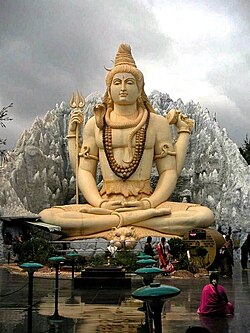

Yoga (Sanskrit: योग Yoga, IPA: [joːgə]) is a group of ancient spiritual practices originating in India. As a general term in Hinduism it has been defined as referring to "technologies or disciplines of asceticism and meditation which are thought to lead to spiritual experience and profound understanding or insight into the nature of existence." Yoga is also intimately connected to the religious beliefs and practices of the other Indian religions.
Outside India, Yoga is mostly associated with the practice of asanas (postures) of Hatha Yoga or as a form of exercise, although it has influenced the entire Indian religions family and other spiritual practices throughout the world.
Hindu texts discussing different aspects of yoga include the Upanishads, the Bhagavad Gita, the Yoga Sutras of Patanjali, the Hatha Yoga Pradipika, the Shiva Samhita, and many others.
Major branches of Yoga include: Hatha Yoga, Karma Yoga, Jnana Yoga, Bhakti Yoga, and Raja Yoga. Raja Yoga, known simply as Yoga in the context of Hindu philosophy, is one of the six orthodox (āstika) schools of thought, established by the Yoga Sutras of Patanjali.
Etymology
The Sanskrit term yoga has a wide range of different meanings. It is derived from the Sanskrit root yuj, "to control", "to yoke", or "to unite". Common meanings include "joining" or "uniting", and related ideas such as "union" and "conjunction" Another conceptual definition is that of "mode, manner, means" or "expedient, means in general".

No comments:
Post a Comment